
Two-Step Login Setup Guide
Detailed instructions on how to set up Two-Step Login. For a shorter version of these instructions, see Get Started with Two-Step Login.
This article applies to: Two-Step Login
This page will guide you through steps for setting up Two-Step Login.
When you set up two-step login for the first time, you can:
- Install and register the Duo Mobile app on a smartphone or tablet.
- Enroll a hardware token, a small device you carry on your keychain. You can purchase hardware tokens online or in person at The Cornell Store.
Set Up Duo Mobile
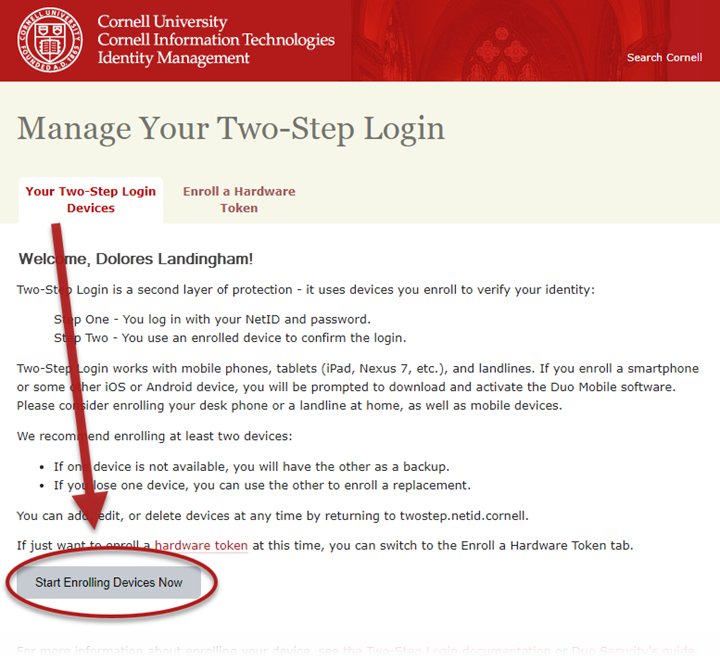
- Sign in at Manage Your Two-Step Login with your NetID and password.
- Select Start Enrolling Devices Now. For instructions on enrolling and using a hardware token, see Hardware Tokens for Two-Step Login.
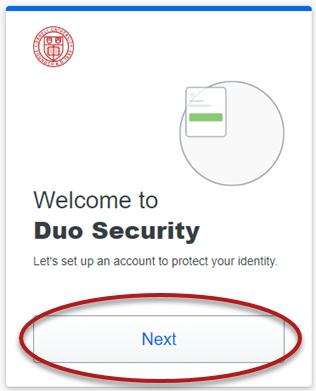
- At the Duo welcome screen, click Next. ("Duo" is the name of the IT security service supporting the Two-Step Login service.)
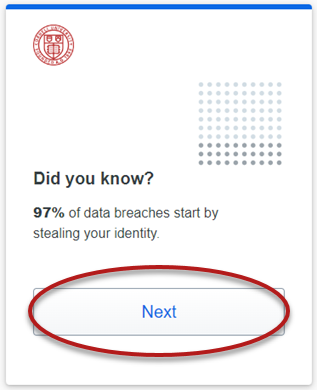
- Duo will provide additional information about online security on the next couple of screens. Read this important information and click Next to advance at each screen.
When you reach the Select an option screen, select .
For first-time setup, use the Duo Mobile app with Cornell’s Two-Step Login. Otherwise, you could end up unable to log in to Cornell services.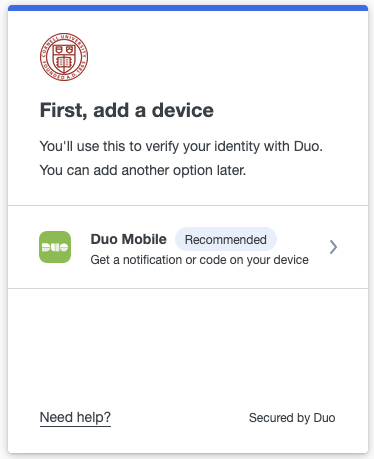
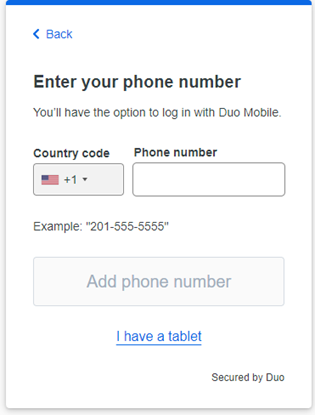
- Type your mobile device's phone number at the Enter your phone number screen. (If you are enrolling a tablet with no phone number, click I have a tablet.)
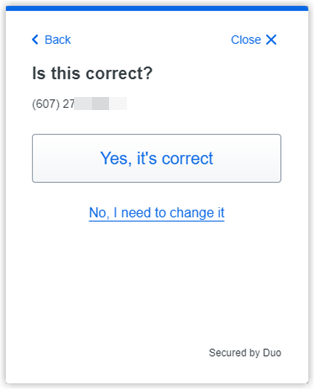
Confirm you have typed the correct number by clicking Yes, it's correct when prompted. If you mistyped or entered an incorrect number, click No, I need to change it and repeat the process.
 If the phone number has already been enrolled in Two-Step Login then you will be required to confirm you physically have the device by having a passcode sent to it, before you can proceed.
- Next, Duo will ask you to download and install the Duo app on the mobile device that you are enrolling.
You can do this by going to the App Store on an iOS device or the Google Play store on an Android device.
Search for "Duo Mobile," published by Duo Security LLC. Install the app on your device, then return to the browser prompt and click Next.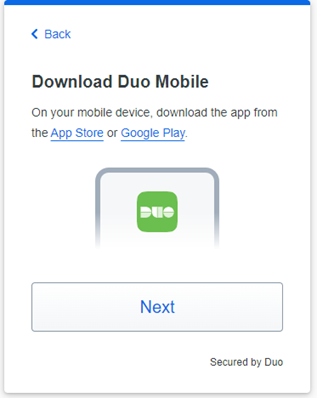
A QR code appears on the Duo enrollment screen. Use the Duo Mobile app on your mobile device to scan the QR code and connect the app to your Two-Step Login account.
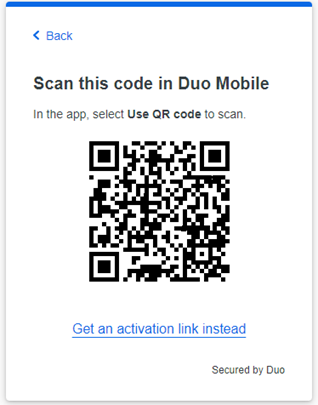 If, for some reason, you are unable to scan the QR code, you can instead send the activation code to yourself by email. To do this, click Get an activation link instead.
Follow the instructions in the email to connect your Duo Mobile app to Two-Step Login.- Duo will confirm that your Duo Mobile app has been added. Click Continue.
Add A Backup Device
After you finish enrolling your first device, you'll be able to use Duo and log in to Cornell systems. What happens if you forget your phone at home, and you need to log in?
Follow these instructions to set up a second option.
If you switch to Secure Connect, keep in mind that Duo Mobile Push, USB security key, or hardware token methods must still be available as a backup, even if you use Secure Connect regularly.
Comments?
To share feedback about this page or request support, log in with your NetID