
Latest News
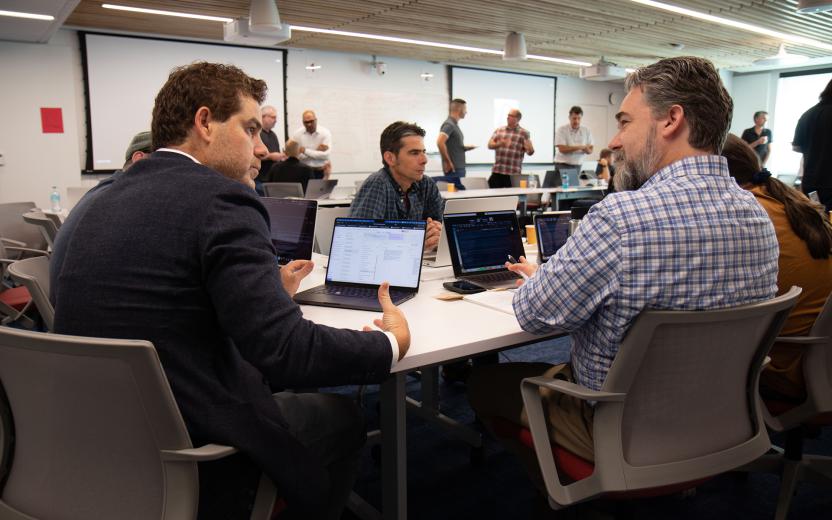
Thirty participants from 23 units across eight colleges, including travelers from Weill Cornell Medicine in New York City and Cornell Cooperative Extension in Suffolk County, gathered in early August to explore what an AI-enabled future of software development might look like at Cornell. Over two days of conversations, experiments, and debate, software engineers, architects, faculty members, program managers, service owners, and other technology professionals examined both a new AI development methodology and the possibility of a university-wide platform that could help a broader community build and deploy AI-powered solutions.
Many arrived with firsthand experience building AI-enabled workflows, applications, and agents. They expected to share tools, compare approaches, and test new ideas. Instead, many left talking about something else entirely: people.
One conclusion kept surfacing: Building the software was not the hard part.
"Building is not what's expensive, and not what's slow. Coming together and deciding what we're building is really what's more expensive," said Ayham Boucher, Executive Director of the Cornell AI Innovation Hub.
It became a recurring theme throughout the workshop. As participants worked through an AI-driven development process, they found that AI could generate code, prototypes, and infrastructure far faster than traditional development approaches. What remained difficult was agreeing on goals, defining requirements, documenting standards, and bringing the right people together to decide what should be built in the first place.
When Building Stops Being the Hard Part
That realization challenged one of the assumptions many people bring to conversations about AI. For decades, software development has been constrained by the time required to write, test, and deploy code. But participants repeatedly described a future in which coding itself becomes relatively inexpensive.
As Boucher put it, "We can have the coding agents build the entire platform. What we want to build is the bottleneck."
Fermin Romero, infrastructure and application development manager in Cornell's Student and Campus Life IT organization, described the shift with an analogy from his childhood. Growing up in Wisconsin, he visited a factory that manufactured machine tools.
"They were building the machines that make the machines," he recalled.
That analogy resonated throughout the workshop. Rather than focusing on building individual applications one at a time, participants increasingly discussed creating blueprints, standards, governance frameworks, and reusable building blocks that could support many future solutions. In that sense, they were not simply building AI applications. They were building the systems that help others build them.
The workshop also served as a test of the AWS AI Development Lifecycle, a methodology that integrates AI throughout planning, development, and deployment while keeping humans responsible for decisions, reviews, and governance.
Several attendees said the workshop changed the way they thought about software delivery altogether.
Chris Garlington, Systems Administrator in the Johnson College of Business, said the process "compresses discovery down to nothing, like a single meeting." The experience suggested that AI's greatest impact could come from accelerating collaboration, helping teams bring the right people together, answer questions immediately, and move from discussion to action more quickly.
Throughout the workshop, participants repeatedly stepped away from their own projects to answer questions, contribute expertise, or compare approaches with colleagues from other parts of the university.
Discussions that might otherwise have unfolded through weeks of separate meetings happened in real time.
The teams compared governance models, service catalogs, documentation practices, and architectural standards, and often discovered they were solving similar problems in different ways. As the discussions evolved, participants placed greater value on sharing lessons learned, governance approaches, and implementation experiences than on demonstrating individual solutions.
Moving Humans Up the Stack
If coding is becoming easier, where does human expertise create the most value?
Small working groups clustered around and outside the room intentionally included a mix of specialists in software engineering, cloud infrastructure, governance, service management, accessibility, communications, and teaching. The focus of their conversations shifted from technology to organizational knowledge: standards, policies, institutional requirements, and the ways different teams solve similar problems.
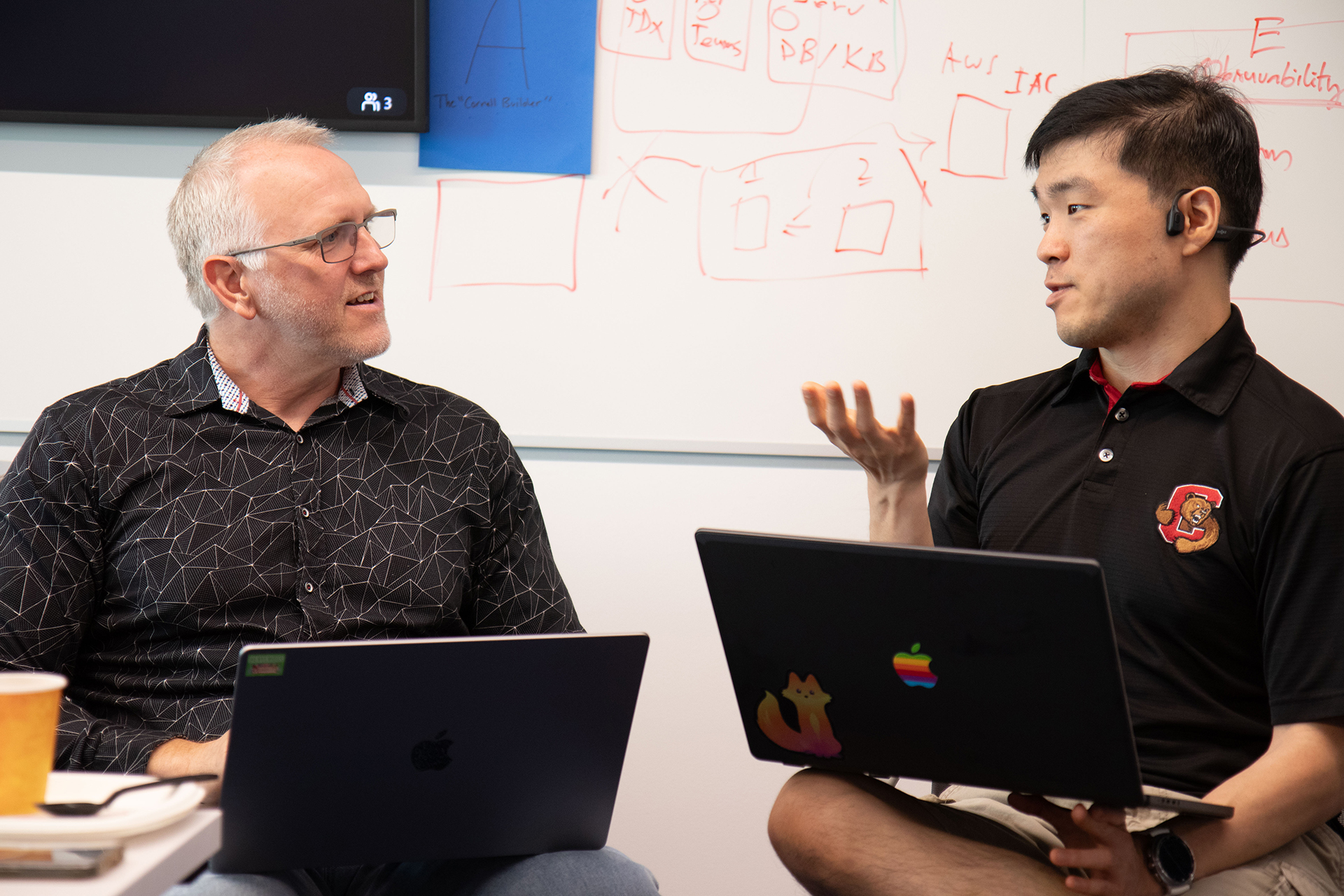
As AI becomes capable of generating larger portions of software systems, many participants argued that human expertise is moving higher up the stack. In other words, the value of technical professionals may be shifting from building software to defining, guiding, and evaluating it.
The irony is that, while AI may reduce the need for some forms of technical collaboration, participants worried it could also make it easier for people to work in isolation.
Boucher observed that AI tools increasingly provide answers that once came from coworkers.
"I can ask my Claude to give me the structure, and now that's less reason for me to talk to Marty," he said.
He wondered if AI-generated prototypes threatened the need to consult designers and developers during early stages of a project, and Garlington asked, "So if I now have more tools that allow me to build longer, is the likely result that we talk to each other less?"
But Ido Efrati experienced the opposite effect. By spending less time on technical implementation, he found himself spending more time with colleagues beyond his immediate team.
"AI has changed the equation for me. I spend less time navigating technical barriers and more time connecting with stakeholders, faculty, and staff to help turn their ideas into solutions," said Efrati, a programmer analyst in Cornell's College of Agriculture and Life Sciences.
That tension may prove to be one of the workshop's most important insights. If AI can reduce the effort required to build solutions, organizations will need to be intentional about how they use the time it creates.
Who Gets to Decide?
Earlier discussions focused on the changing role of technical professionals. Instead of spending most of their time writing code, participants described defining goals, designing guardrails, reviewing AI-generated work, and translating human needs into instructions AI systems can understand.
The conversation about collaboration quickly led to another realization: if AI can build more technical solutions, humans increasingly become responsible for deciding how those solutions should be built. Who ensures they meet security requirements, accessibility standards, and institutional policies?
Participants also worried that the rapid democratization of AI development could create new challenges.
Garlington warned that without those standards, "People are just going to build their own agents themselves, and we'll get a Wild West situation."
The group's emerging answer was not more oversight after software is created, but more guidance before it is created.
The concept they repeatedly returned to was encoding institutional standards, architectural patterns, and governance requirements into reusable frameworks that human builders and AI agents alike could follow.
The conversation eventually expanded beyond software development itself and toward the role people would continue to play in an AI-enabled future.
That idea resonated with Cornell Chief Information Officer Ben Maddox, who challenged participants to think beyond the tools themselves.
"AI tools and products are the commodities. What is the scarcest resource we have is you. Your creativity, your time, your productivity, your willingness and enthusiasm about collaborating in new ways," said Maddox.
His remarks echoed a broader conclusion emerging from the workshop. The most valuable outcome was not a chatbot, a prototype, or even a new platform. It was the opportunity for people from across Cornell to work together on a shared problem, and to rethink where human expertise creates value in an AI-enabled world.
Marty Sullivan, Assistant Director & Principal Solutions Architect for the AI Platform, observed that the workshop's structure helped dissolve organizational boundaries that often separate teams.
"What's been neat is these people came from all over. We did our intros, but it didn't matter what org anyone came from. It's a good way to bring everybody together," Sullivan said. "We brought real cross-unit problems into the room. The question now is whether this becomes how we work going forward, or whether we go back to individual teams sharing ideas but rarely solving those problems together."
The workshop's participants may have arrived expecting to spend two days exploring AI, but they ultimately left with a deeper appreciation for the human work that drives the process.
Comments?
To share feedback about this page or request support, log in with your NetID