
Latest News
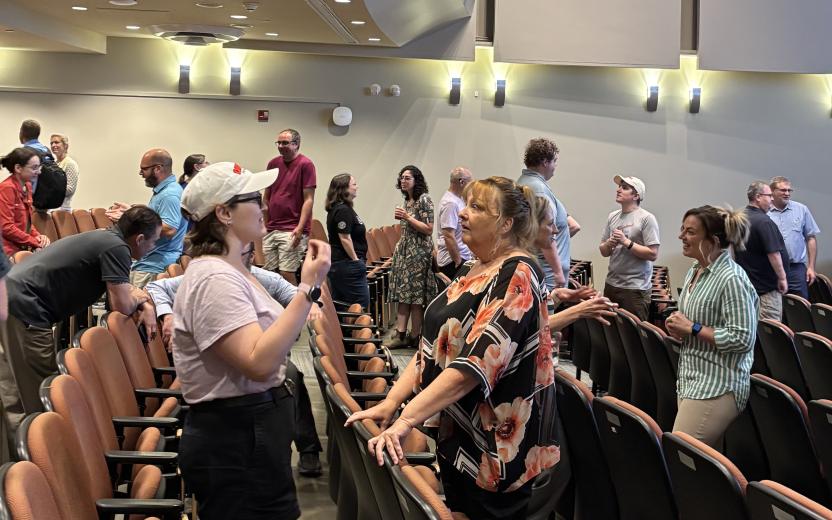
Leaders at Cornell's first All-IT Town Hall outlined the next phase of the Evolve IT initiative, emphasizing stronger collaboration, community, and shared capabilities while preserving the local expertise and relationships that support colleges, units, and campuses across the university.
When Debra Howell, Director of Information Technology for the University Libraries, opened the event, she reflected on Berlin when the city was divided by the Berlin Wall. Communities on both sides continued to live and work, she noted, but the barrier limited broader collaboration and created distance between groups that might otherwise have accomplished more together.
The analogy set the tone for a broader discussion about the university’s IT community, one defined by deep expertise, strong local relationships, and a long history of service, with opportunities to strengthen collaboration and connections across teams.
Howell was joined onstage by Ben Maddox, Chief Information Officer, Sarah Christen, Deputy Chief Information Officer, and Ashley Percey, Director of Public Safety Communications and Technical Systems. Andrea Frank, Assistant Director for Project Management, monitored questions from the in-person audience, while Beth Goelzer, Director of IT Customer Experience, engaged with the Zoom audience. Even an unexpected fire alarm did not quench audience participation.
Each of the speakers reinforced the theme of connection throughout the July 14 event, where leaders outlined the next phase of the Evolve IT initiative and introduced the newly established Information Technology organization. Maddox emphasized that the effort represents an evolution of Cornell's federated IT model. The goal is to strengthen collaboration and community while preserving the local expertise and support that colleges, schools, and units rely on.
Many Teams, One Community
Cornell's IT community includes more than 850 professionals working across 31 colleges and units. The average IT employee has served the university for 17.5 years, and recent retirees averaged more than 35 years of service. Those numbers reflect both the depth of institutional knowledge across the university and the opportunity to strengthen connections across a highly experienced workforce.
Throughout the discussion, Maddox described the new IT organization as a "quilt"—a collection of skilled and dedicated teams united by a common purpose. Through strong collaboration, the organization will identify opportunities to be simpler, more efficient, more consistent, and more sustainable while preserving the local partnerships and expertise that support Cornell’s academic, research, and community missions.
Christen shared a roadmap for the coming year. Following the formal establishment of Information Technology as a new organization this month, implementation teams will begin forming and defining scope this summer. The focus will shift to culture building in fall 2026, pilot programs during winter 2027, and broader onboarding and rollout efforts in spring 2027. Maddox said the initial work is intended to create practical roadmaps for the next two years, establishing a foundation for future phases.
Governance and leadership structures will continue to evolve alongside the initiative. Christen will chair a steering committee overseeing the implementation teams, which are focusing on classroom and audiovisual technology, client services, software procurement, design standards for custom-built applications, research computing, and workforce readiness. Important work in areas such as policy, security, tools, AI, and service management will increasingly be advanced through cross-organizational committees that bring together perspectives from across IT.
As IT evolves, workforce readiness will be a more intentional and coordinated effort across the organization. Howell described workforce readiness as more than traditional change management. In today's technology environment, she said, staff operate in a constant state of change, making adaptability, flexibility, and resilience essential skills. Workforce readiness efforts will help ensure employees have the skills, support, and opportunities needed to grow, innovate, and thrive as technologies, priorities, and service expectations continue to evolve.
Comments?
To share feedback about this page or request support, log in with your NetID