
Latest News
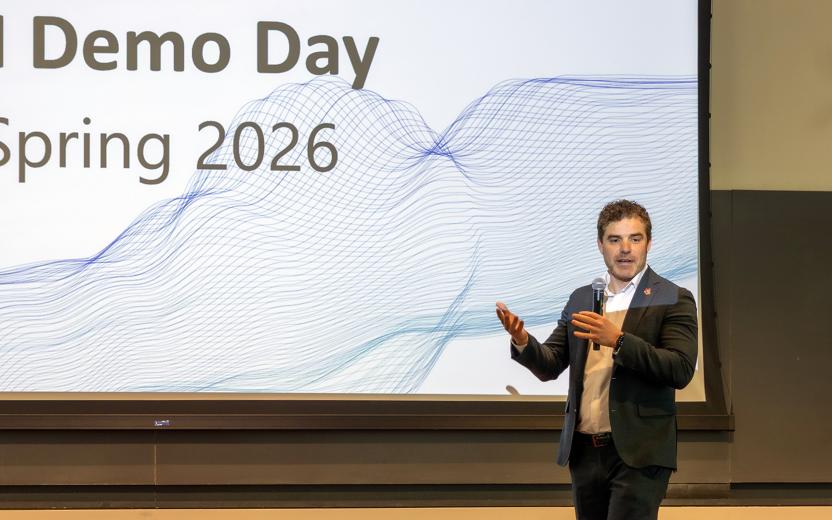
On May 4, 2026, Cornell’s direction for AI innovation was emphasized early and often: don’t start with the technology, start with the problem. That framing set the tone for the university’s latest AI Demo Day, where students, faculty, and staff presented projects rooted in real campus needs.
Rather than positioning AI as a replacement for people, speakers emphasized collaboration between technologists and domain experts, students and staff, and humans and machines in building tools that are operationally relevant, secure, and human-centered.
From inaccessible archival materials and high-friction administrative workflows to leadership skills that students once developed only in their first three to five years on the job, the fast-paced agenda highlighted roughly a dozen distinct challenges. Each was addressed through human-centered design and a thoughtful application of AI tools tailored to the work at hand.
Together, the demos offered a snapshot of how AI is being applied across the university today, not as a standalone solution, but as part of interdisciplinary, human-centered systems that support teaching, research, and daily operations.
Hosted by the university's AI Innovation Hub, the event opened with a reminder tied closely to Cornell’s mission of discovery. Preparing students for an AI-infused future requires more than teaching technical skills. It also requires giving learners opportunities to work across disciplines, adapt to messy real-world conditions, and understand the social, ethical, and organizational contexts in which AI systems operate.
Making Invisible Work Visible
Many of the projects addressed operational challenges—largely unseen yet critical to how the university functions.
Team members working with Student Disability Services demonstrated an AI-assisted exam-scheduling system designed to manage the growing complexity of alternative exam arrangements for students requiring accommodations. By combining optimization software with AI-supported modeling and requirements gathering, the project aims to reduce the heavy manual workload placed on a small number of staff while improving consistency and scalability.
Other teams focused on finance and administrative workflows, including travel reimbursements, invoice processing, and accounts payable. These systems use AI to handle initial triage—such as matching receipts, identifying missing information, or flagging compliance issues—while keeping humans firmly in the loop for validation and oversight.
In several cases, teams noted an unexpected benefit: once processes were automated and instrumented, departments gained visibility into recurring issues that had previously been buried in manual work. New dashboards and reports surfaced insights that enabled broader process improvements beyond simple time savings.
Learning, Leadership, and Human Skills
Several projects focused on helping people practice complex human skills that are difficult to teach or scale through traditional methods.
To foster staff upskilling, one department’s presentation described staff members’ pursuit of AI literacy together through a certification program, peer discussions, and regular learning sessions. That shared approach accelerated adoption and shifted AI from an individual experiment into a team capability.
Another team partnered with the Selander Center for Engineering Leadership to create an AI-powered leadership coaching tool that allows students to practice difficult workplace conversations, such as giving upward feedback to a manager. Instead of static role plays, the system simulates interactive conversations with varying levels of difficulty and provides structured feedback on communication style, clarity, empathy, and tone.
The goal is not to replace human instruction, but to give students a safe, repeatable environment where they can practice leadership skills, make mistakes, and learn from targeted feedback—something that is often difficult to provide at scale in real workplace settings.
AI for Research, Scholarship, and Evidence
Several demos highlighted how AI can support rigor, transparency, and accessibility in research.
A collaboration with the Cornell University Library showcased a system for transcribing handwritten archival materials into accessible, searchable formats. Designed to meet accessibility standards, the workflow blends AI transcription with editorial guidelines and validation steps, making fragile historical materials more usable for researchers and the public.
In the humanities, a historian described using AI-supported transcription and summarization to work with thousands of handwritten documents across multiple languages—turning what was once time-consuming preparatory work into a foundation for deeper analysis, verification, and interpretation.
Other projects focused on synthesizing complex evidence. A multi-agent biomedical research platform demonstrated how AI agents can gather, compare, and synthesize findings from scientific literature, knowledge graphs, and real-world clinical data—while ensuring that every claim remains traceable to its original source. Presenters emphasized that transparency and auditability were core design principles, particularly in high-stakes domains like medicine.
Building Infrastructure, Not Just Prototypes
Midway through the event, attention shifted “under the hood,” with platform teams outlining the AI infrastructure that supports these projects. Marty Sullivan, assistant director and principal solutions architect for the AI Innovation Hub, described how Cornell is building secure, governed access to multiple AI models and tools—enabling everything from conversational assistance to more advanced agent-based workflows.
Rather than treating AI projects as isolated experiments, the platform approach aims to make successful tools reusable, scalable, and sustainable across the university, while embedding governance, security, and compliance from the start.
Looking Ahead
Closing remarks pointed to a shift now underway: moving from volunteer-driven experimentation to more formal staffing and investment. Announcements included the launch of a new workplace innovation team and AI Fellow roles focused on operational and administrative use cases—signaling Cornell’s intent to sustain and grow this work.
University leaders described Cornell’s approach as intentionally human-centered. AI is not seen as a replacement for people, but as a way to empower faculty, staff, and students to do their work more effectively, creatively, and ethically.
As this AI Innovation Hub Demo Day made clear, the most compelling innovations are emerging not just from new algorithms or tools, but from collaboration—across disciplines, between humans and machines, and throughout the academic and administrative fabric of the university.
Comments?
To share feedback about this page or request support, log in with your NetID